

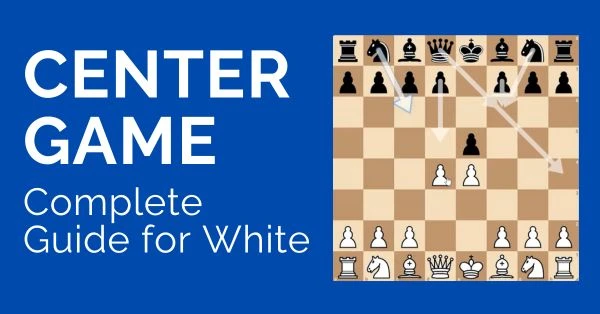

The Center Game is a relatively easy-to-learn and provocative opening for White. A lot of Black players don't give the Center Game enough credit. It's a very aggressive and ambitious way to start the game.
One of the positives of being an amateur player is that you can choose from a wide range of openings.
Chess Tips, Articles and Guides to Help You Win Chess Games

Nimzo Semi-Tarrasch Defense for Black combines the power of the Queen’s Gambit Declined and the attacking potential of Tarrash and Grunfeld.
Continue reading
Learn GM Marian Petrov’s Ponziani Opening fundamentals in just 3 hours.
Most chess players don’t even know this opening exists.
It is extremely rare, yet powerful.
Continue reading
The great news is, IM Sieciechowicz is here with a quick-and-easy repertoire on the Bayonet Attack! And you are one click away from learning it!
Continue reading
Every chess player trains hard in order to see improvement in their play and, after all the hours invested, the accumulated knowledge is tested in tournaments. As we have mentioned in some of our previous articles, it is important that you choose strong tournaments where you are able to measure your forces with players who are stronger than you.
Continue reading
Many club players feel that after a long time of studying chess they don’t see enough progress in their chess. This brings a feeling of depression and it sometimes leads to quitting the usual training plan or the idea of making progress in chess. However, thinking that you are not good enough or that you are not going to make it and deciding to settle for club play only is not the answer. You should review your training schedule, look for any mistakes you are making or just keep training harder; the results will most certainly show.
Continue reading
The daily chess training is something every ambitious player should take seriously. No matter what your rating is, if your goal is to become a better player within a short period of time you must train regularly and actively. This is, of course, an obvious observation, the question is how? What exactly should you be doing in order to achieve your goal?
Continue reading
Free Video Download
Learn how chess masters make decisions and start winning games


